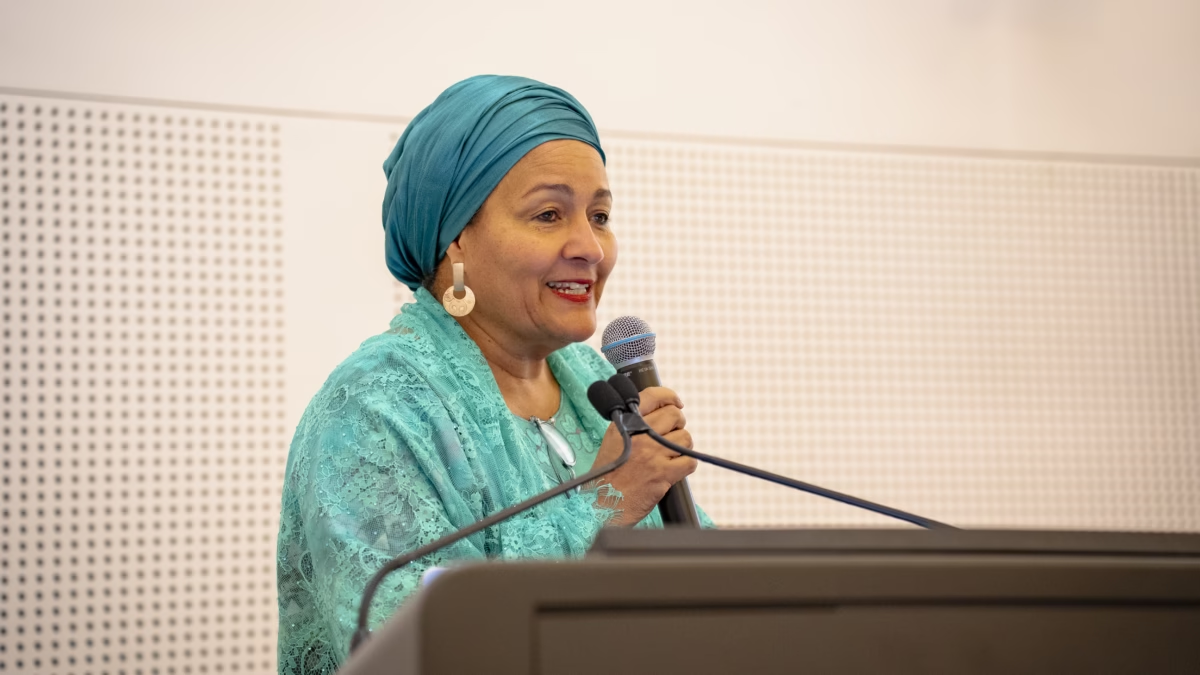
In a landmark opening address in Narrm (Melbourne), Amina Mohammed delivered a speech that was equal parts warning and rallying cry — naming the crisis, naming the resistance, and calling every government, civil society organisation, and community in the room to account. Emerge was there.
By Emerge Magazine | 27 April 2026 | Narrm (Melbourne) | emergemagazine.com.au
The Women Deliver 2026 Conference opened this morning in Narrm (Melbourne) before more than five thousand delegates from over 170 countries — and the United Nations Deputy Secretary-General, Amina Mohammed, did not come to celebrate. She came to challenge.
Speaking at the opening plenary, titled ‘Change Calls Us Here’, Mohammed delivered a speech that moved between the personal and the systemic, the Pacific and Nigeria, the hopeful and the unflinching. For Emerge Magazine, reporting live from the conference floor, it was the kind of opening that sets a tone not just for four days but for the decade of work ahead.
Thirty years after Beijing, we are still arguing over a woman’s body
Mohammed opened by acknowledging the Wurundjeri people of the Kulin Nation, on whose land the conference is being held, and by paying respects to First Nations, Aboriginal and Torres Strait Islander, Māori and Pacific women in the room. The acknowledgement was not ceremonial — it was foundational to the argument she was about to make.
She then named the stakes plainly: three decades after the Beijing Declaration on women’s rights, and thirty-one years after the Cairo Programme of Action on reproductive rights, the world is still fighting battles that should have been won a generation ago.
“Three decades after Beijing, thirty-one years after Cairo, we are still arguing with men over whether a woman’s body belongs to her. That is the work we inherited.”
Amina Mohammed, UN Deputy Secretary-General, WD2026 Opening Plenary
For the multicultural and diaspora women Emerge serves in Greater Geelong and regional Victoria — many of whom have navigated the health systems, legal systems, and political systems of more than one country — that line landed with particular force. The work is not abstract. It is the reality of their lives.
The weight lands on women — every time
Mohammed spoke directly to the compounding crises of the current moment: the aftermath of COVID-19, ongoing global conflicts, and the accelerating impacts of climate change. Her message was consistent across all three: wherever the crisis is sharpest, it is women and girls who carry the weight of it.
She drew on a recent visit to Nigeria, where she witnessed the reality of artisanal mining in communities caught between extraction economies and conflict.
“Women and children with shovels, hauling loads that should not be on any human back. Whole communities damaged and suffering so that their own minerals are extracted for foreign use.”
Amina Mohammed, UN Deputy Secretary-General
The image was stark — and deliberate. Mohammed was not describing a distant problem. She was naming a pattern: that wherever resources are extracted, wherever conflict flares, wherever the climate is cruellest, women and girls are found at the bottom of it. And they are not there by accident.
For Emerge’s readers with connections to communities across Africa and the Pacific, this was not a news story. It was recognition.
A structural shift: UN Women and UNFPA to merge
The most significant policy announcement of the opening plenary came midway through Mohammed’s remarks, when she outlined a proposed reform that would reshape the United Nations’ gender equality architecture.
Mohammed announced that under Secretary-General António Guterres’ UN80 reform agenda, the UN is proposing to bring UN Women and UNFPA together into a single entity — with a presence in over 130 countries and a combined operational budget of approximately USD 2.2 billion.
“For civil society, it would mean a single entry point, with greater access and amplification of your message for your advocacy and rights work.”
Amina Mohammed, UN Deputy Secretary-General
The proposal is significant for community organisations, multicultural media, and advocacy groups working in diaspora and migrant communities. A single entry point to the UN’s gender equality work — with a larger operational footprint — could represent a meaningful shift in how grassroots voices reach global institutions. The details of the merger are still being developed, but the direction is clear.
To governments: back your commitments with legislation
Mohammed’s closing call was directed at every seat of power in the room. To governments, she was direct: commitments made at conferences like WD2026 must be backed by legislation, not left as declarations. To civil society, she asked for harder pressure on accountability. And to the United Nations itself, she made a commitment: to take what was said in this room back to New York, and to amplify it.
“We will not cede this space, not an inch of it. We need to take back ground from the people trying to drag it away.”
Amina Mohammed, UN Deputy Secretary-General
For Emerge, sitting in that room as an official media partner and as a publication built on and for communities that have spent decades being marginalised from exactly these conversations — the charge felt personal.
Change called us here. The rest, as Mohammed said, is in our hands.
Emerge is on the ground at WD2026
Emerge Magazine is an official media partner for Women Deliver 2026, providing daily coverage from the conference floor from 27–30 April. Our reporting focuses on the sessions, voices, and commitments most relevant to multicultural and diaspora women across Greater Geelong and regional Victoria.
Follow our live coverage at emergemagazine.com.au and on Instagram and LinkedIn. Day 2 dispatch publishes tomorrow.
About Emerge Magazine
Emerge is an official media partner for Women Deliver 2026. Visit emergemagazine.com.au